
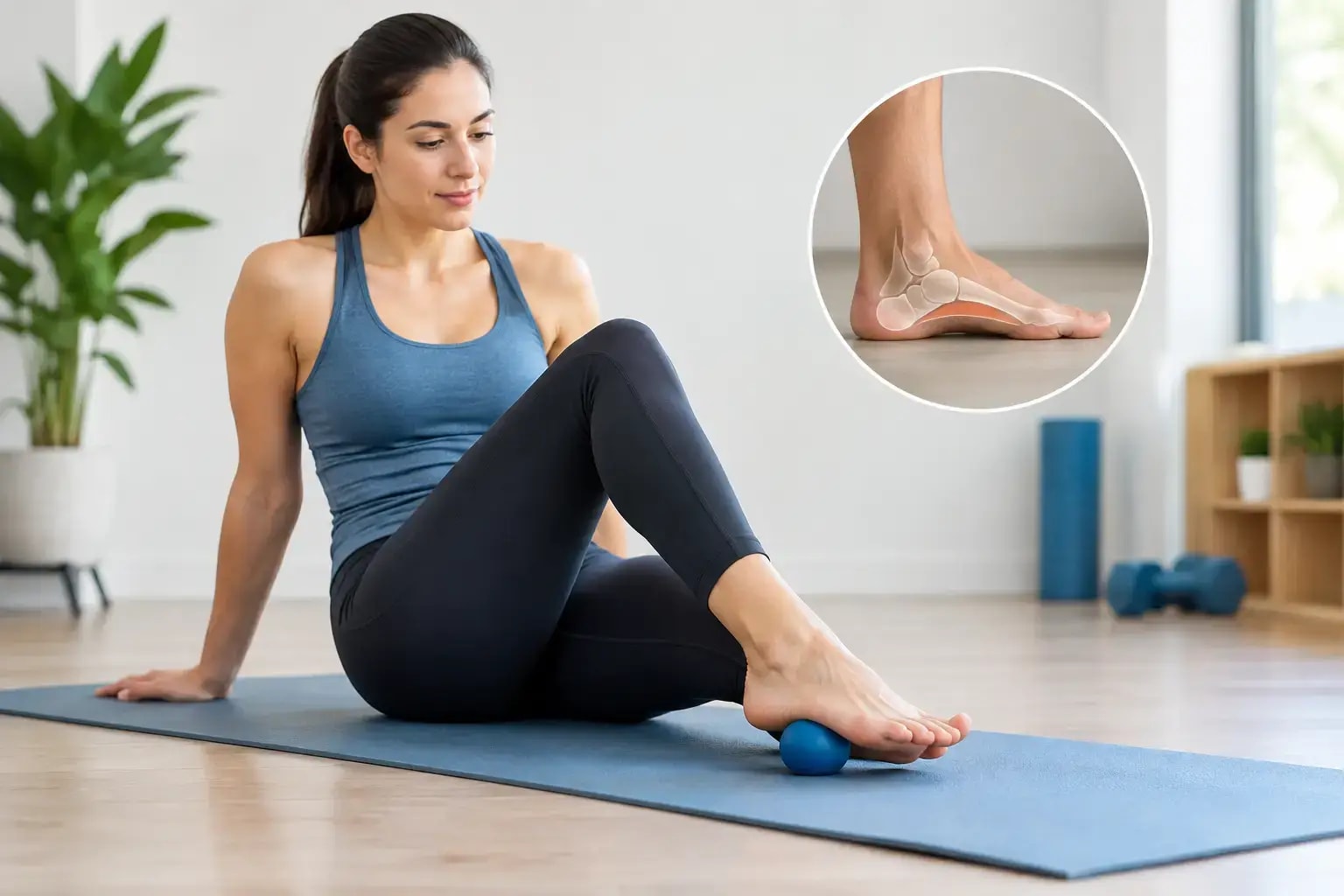
A foot that rolls inward during walking can place extra load on the arch, heel, ankle, knees and lower legs. The best exercises for flat feet can improve muscular control and comfort, but they need to suit the way your feet move and the symptoms you are experiencing. An exercise that helps a flexible, painless flat foot may not be appropriate for a rigid foot, a painful tendon or an active sports injury.
Flat feet, also called pes planus, describe a lowered arch. Some people have them from childhood and have no pain or limitation at all. Others notice aching through the arch, heel or inside of the ankle, fatigue on longer walks, frequent shin discomfort, or shoes that wear down quickly on the inner edge. The aim of exercise is not necessarily to create a visibly high arch. It is to improve the strength, control and load tolerance of the foot and lower limb.
When exercises for flat feet can help
The arch is supported by more than one structure. Ligaments and fascia provide passive support, while muscles in the foot, calf and lower leg help control motion as you stand, walk, run and change direction. Weakness, reduced balance, tight calves and poor hip control can all contribute to excessive pronation, where the foot rolls inward more than it can comfortably manage.
Targeted exercise can be particularly useful where flat feet are flexible: the arch appears when you sit or rise onto your toes, but lowers with standing. It can also be a valuable part of treatment for people returning to activity after heel pain, posterior tibial tendon irritation or a lower-limb injury.
However, exercises are not a substitute for assessment when pain is persistent, the foot has become noticeably flatter on one side, swelling develops around the inside ankle, or you cannot rise onto the ball of one foot. Children with pain, frequent tripping or concerns about walking should also be assessed individually. A podiatrist can determine whether strengthening, footwear changes, prescription orthotics or further investigation is appropriate.
8 best exercises for flat feet
Start slowly and keep the movements controlled. Mild muscle effort is expected; sharp pain, increasing tendon pain or pain that lingers into the next day means the exercise should be reduced or stopped.
1. Short-foot arch raises
This is one of the most useful exercises for training the small stabilising muscles beneath the foot. Sit with your foot flat on the floor. Without curling your toes, gently draw the ball of the foot towards the heel so the arch lifts slightly. Your toes should stay long and relaxed.
Hold for five seconds, then relax. Aim for two sets of eight to 12 repetitions on each side. Once this feels controlled while seated, practise it standing, then during simple tasks such as brushing your teeth. The movement should be subtle, not a hard clawing action with the toes.
2. Toe control exercises
Good toe control helps the foot adapt to the ground and contributes to balance. With your foot flat, lift your big toe while keeping the smaller toes down. Then reverse it: press the big toe down and lift the smaller toes. It can feel surprisingly difficult at first, particularly if the toes are stiff or have spent years compressed in narrow footwear.
Perform eight to 10 slow repetitions of each pattern. If the smaller toes will not lift separately, simply practise spreading them gently and pressing them into the floor. Consistency matters more than perfection.
3. Calf raises with arch control
The calf muscles and posterior tibial tendon play a major role in supporting the foot as you push off. Stand near a bench or wall for balance. Set a gentle short-foot position, then rise evenly onto the balls of both feet. Keep the heels moving straight up rather than allowing the ankles to roll inwards.
Lower slowly for a count of three. Begin with two sets of 10 repetitions. Progress to single-leg calf raises when you can complete the movement without pain or loss of alignment. For runners and active people, this progression is often more valuable than doing large numbers of fast repetitions.
4. Resistance-band foot inversion
This exercise targets the muscles along the inner lower leg, including the posterior tibial muscle. Sit with your legs out straight and loop a resistance band around the forefoot, anchored to the outside of the foot. Keeping the knee still, slowly turn the sole of the foot inward against the band.
Return with control rather than letting the band pull your foot back. Complete two sets of 10 to 15 repetitions. You should feel effort along the inner shin or ankle, not a sharp pull directly over a sore tendon. If you have pain or swelling behind the inside ankle bone, seek advice before loading this area.
5. Calf stretch with the knee straight and bent
A tight calf can limit ankle movement and encourage the foot to compensate by rolling inward. Stand facing a wall with one foot behind you. Keep the back knee straight and heel down as you lean forward until you feel a stretch through the upper calf. Hold for 20 to 30 seconds.
Then bend the back knee slightly while keeping the heel down. This changes the stretch to the deeper calf muscle, which is especially relevant when ankle movement is restricted. Repeat each position two or three times per side. Stretching should feel firm but comfortable, never painful.
6. Single-leg balance
Balance training teaches the foot, ankle and hip to respond to small changes in position. Stand near a wall or kitchen bench and balance on one foot for 20 to 30 seconds. Maintain a relaxed arch position and avoid gripping with the toes.
When this becomes easy, try it with small head turns, on a firmer cushion, or while reaching one hand forward. Do not progress to an unstable surface if you have poor balance or a high falls risk. For older adults, a secure support nearby is essential.
7. Step-downs for ankle and knee control
Flat-footed posture is often influenced by the whole lower limb, not the foot alone. Stand on a low step with one foot near the edge. Slowly lower the opposite heel towards the floor, then return to standing. Keep the working knee tracking roughly over the second toe and prevent the arch from collapsing inward.
Start with six to eight repetitions per side. A low step and slow pace are enough. If you feel knee pain or cannot control the movement, reduce the height or return to single-leg balance and calf raises first.
8. Hip abduction strength work
The muscles at the side of the hip help control the leg as the foot meets the ground. Lie on your side with the lower knee bent and the top leg straight. Lift the top leg slightly behind your body, keeping the pelvis still and the toes facing forward. Lower slowly.
Two sets of 10 to 15 repetitions per side is a practical starting point. You should feel the outer hip working, not the lower back. Stronger hip control will not change your foot shape, but it can reduce the inward collapse that places extra strain on the foot and ankle during walking or running.
Building a realistic routine
Most people do better with a short routine performed regularly than an ambitious programme that is abandoned after a week. Choose three or four exercises to complete three times weekly, allowing a rest day between strengthening sessions if your feet or calves are sore. Calf stretching can usually be done more often, provided it remains comfortable.
For example, begin with short-foot raises, toe control, double-leg calf raises and calf stretches. After two to three weeks of good control, add banded inversion and single-leg balance. Step-downs and hip exercises are useful next steps for people returning to longer walks, gym training or sport.
Footwear also affects how the exercises feel. A supportive shoe with enough width through the toe box can make walking and strengthening more comfortable while the foot builds capacity. If your shoes are very worn, unstable or painful, replacing them may be as relevant as adding another exercise.
When a personalised plan is the better option
Persistent pain is not something to train through. Heel pain, tenderness along the inside ankle, recurrent shin pain, numbness, worsening bunion symptoms or reduced walking tolerance can each require a different approach. Flat feet may be one factor, but they are not always the sole cause.
At Manly Foot Clinic, assessment can include examination of joint movement, muscle strength, walking pattern and footwear, with gait analysis and prescription orthotics considered where clinically appropriate. Orthotics can support a painful or overloaded foot while an exercise programme improves strength and control, but they are not automatically necessary for every flat foot.
Comfortable movement is the useful measure. If a well-paced routine helps you walk, exercise or stand with less discomfort and more confidence, keep building gradually. If it does not, a clear diagnosis is the best next step.