
What are hammer toes?
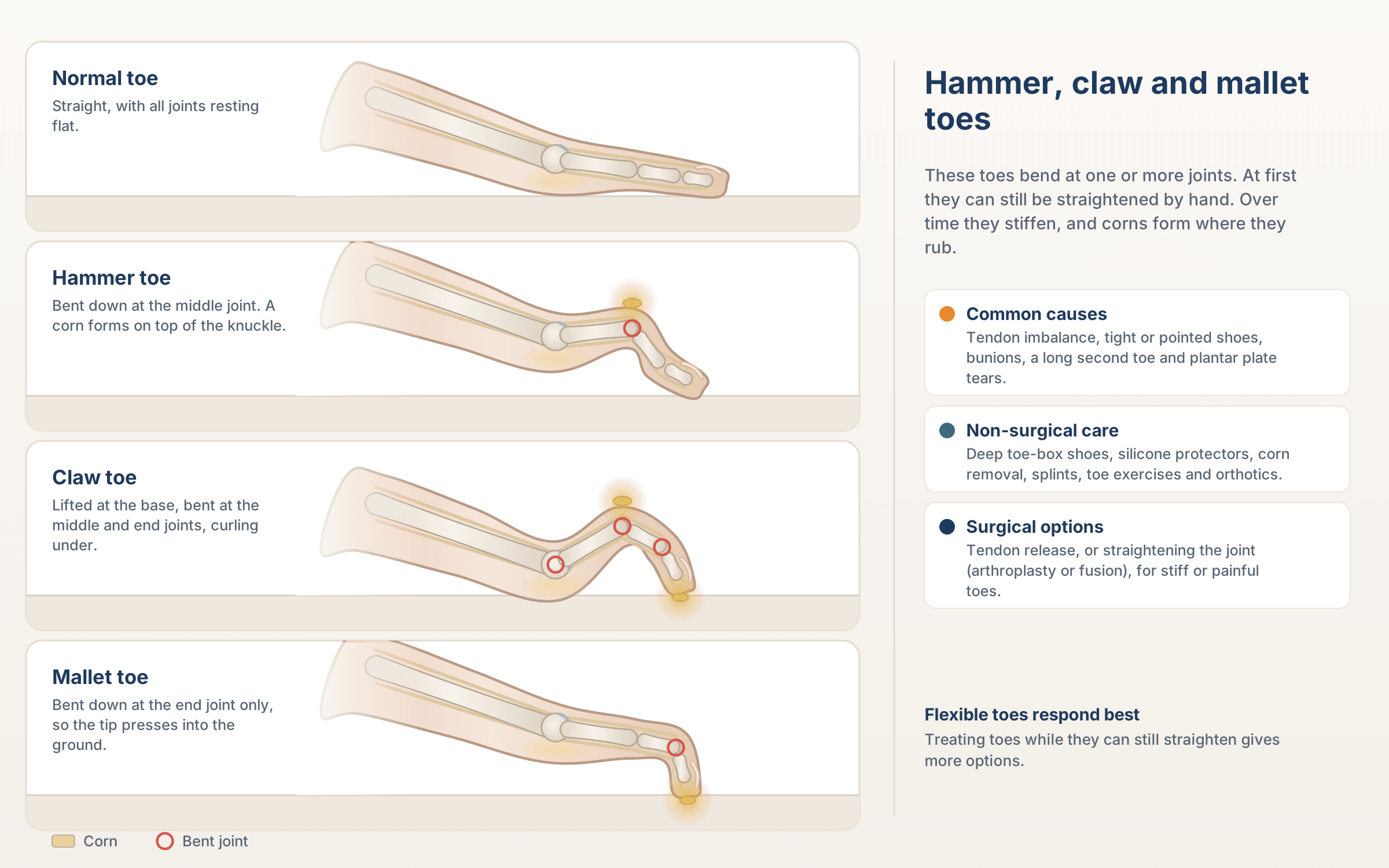
A hammer toe is a deformity of one of the smaller toes where the toe bends at one or more of its joints, so it no longer lies flat. Hammer toes are most common in the second toe, but can affect any of the lesser toes.
Types of lesser toe deformity
- Hammer toe: bent upward at the toe’s base and downward at the middle joint, so the toe looks like an upside-down V. Corns often form on top of the middle joint.
- Claw toe: bent upward at the base and downward at both the middle and end joints, so the toe curls under like a claw. Often affects several toes.
- Mallet toe: bent downward at the end joint only, so the tip of the toe presses into the ground, causing a corn on the tip.
- Curly toe: a toe that curls under its neighbour, common in children.
- Crossover toe: usually the second toe drifting over the big toe, often due to a plantar plate tear.
Flexible or rigid?
In the early stages, a hammer toe is flexible: you can straighten it by hand. Over time, the tendons and joint capsule tighten and the toe becomes rigid, fixed in its bent position. Flexible toes respond better to non-surgical care.
What causes hammer toes?
- Muscle imbalance: the small muscles and tendons that control the toes become unbalanced, pulling the toe into a bent position
- Footwear: narrow, short or high-heeled shoes that cramp the toes
- Bunions, which crowd the lesser toes
- A long second toe or metatarsal
- Plantar plate tears, which let the toe drift upward
- Genetics and foot shape, including high arches
- Arthritis and nerve conditions, including diabetes
- Injury to the toe
Symptoms to look out for
- A bent toe that doesn’t lie flat
- Corns on top of the toe, on the tip, or between the toes
- Pain or rubbing in shoes
- Redness or swelling over the toe joints
- Pain under the ball of the foot
- A toe that’s become stiff and can’t be straightened
- Open sores on the toe, especially if you have diabetes, which need urgent care
How are hammer toes diagnosed?
Your podiatrist will examine the toes to see which joints are bent and whether the deformity is flexible or rigid. We check for corns and pressure areas, test the stability of the toe joints for a plantar plate tear, assess your bunion if you have one, and look at how you walk and the shoes you wear. X-rays are taken when surgery is being considered, to see the alignment of the bones and joints.
Non-surgical treatment
- Footwear: shoes with a deep, wide toe box and soft uppers, and a low heel
- Padding and protection: silicone toe protectors, crests and sleeves to cushion corns and pressure points
- Corn and callus removal, for instant relief
- Strapping and splints to hold flexible toes in a better position
- Toe exercises to strengthen the small foot muscles, for flexible toes
- Custom orthotics, made from a 3D scan of your feet, to improve foot function and reduce pressure under the ball of the foot
When is surgery needed?
Surgery is considered when a hammer toe has become rigid and painful, keeps forming painful corns, or has developed an open sore, and non-surgical care hasn’t helped. Hammer toes are often corrected at the same time as a bunion or plantar plate tear.
Dr Ozan Amir, Surgical Podiatrist, will assess your toes and X-rays and recommend the procedure that suits your deformity. Options include:
- Tendon release (tenotomy): releasing a tight tendon to straighten a flexible toe. Often a minor procedure done under local anaesthetic.
- Digital arthroplasty: removing a small piece of bone at the bent joint to straighten the toe.
- Digital arthrodesis (fusion): fusing the bent joint in a straight position, sometimes held with a small pin or implant while it heals.
- Tendon transfer and plantar plate repair: for toes that have drifted upward at the base.
- Metatarsal shortening: where a long metatarsal is contributing.
Minor procedures are performed at the clinic, and more complex surgery in a day surgery hospital. Recovery depends on the procedure and the number of toes corrected, and Ozan will explain what to expect, and the risks, before anything is booked.
Hammer toes and curly toes in children
Curly toes are common in young children and often run in families. Many improve as children grow. If a curly toe is causing pain, blisters or nail problems, simple taping or, in some cases, a minor tendon release can help.
Watch Dr Ozan Amir explain
Surgical Correction of Hammertoe Deformity
Tenotomies Can Work Well for Flexible Hammertoes
Surgical Correction of Mallet Toes
Surgical Correction of an Elevated Fifth Toe – Digiti Quinti Varus
How to Treat Curly Toes in Children
This Is What the Plantar Plate Looks Like
Hammer Toes FAQs
Flexible hammer toes can often be managed with footwear, padding, splints and exercises. Once a toe has become rigid, only surgery can straighten it.
Hammer toes often gradually stiffen over time, especially if footwear is crowding them. Early management can slow this.
It depends on the procedure. A tendon release has a quick recovery, while a joint fusion takes longer, often several weeks in a protective shoe. Ozan will give you a timeline for your procedure.
Yes. Pressure on hammer toes can cause corns and sores that may not heal well with diabetes. Regular podiatry care and the right footwear are important, and any open sore needs prompt attention.
No, you can book directly. If your appointment is through a Medicare care plan, DVA or another funded program, you’ll need a referral, so check with us when you book.
Serving Manly and the Northern Beaches.
Manly Foot Clinic is at Shop 3/3 Corrie Rd, North Manly NSW 2100. We see patients from Manly, Balgowlah, Freshwater, Dee Why and Brookvale through to Mosman, Neutral Bay, Chatswood and the wider North Shore.