
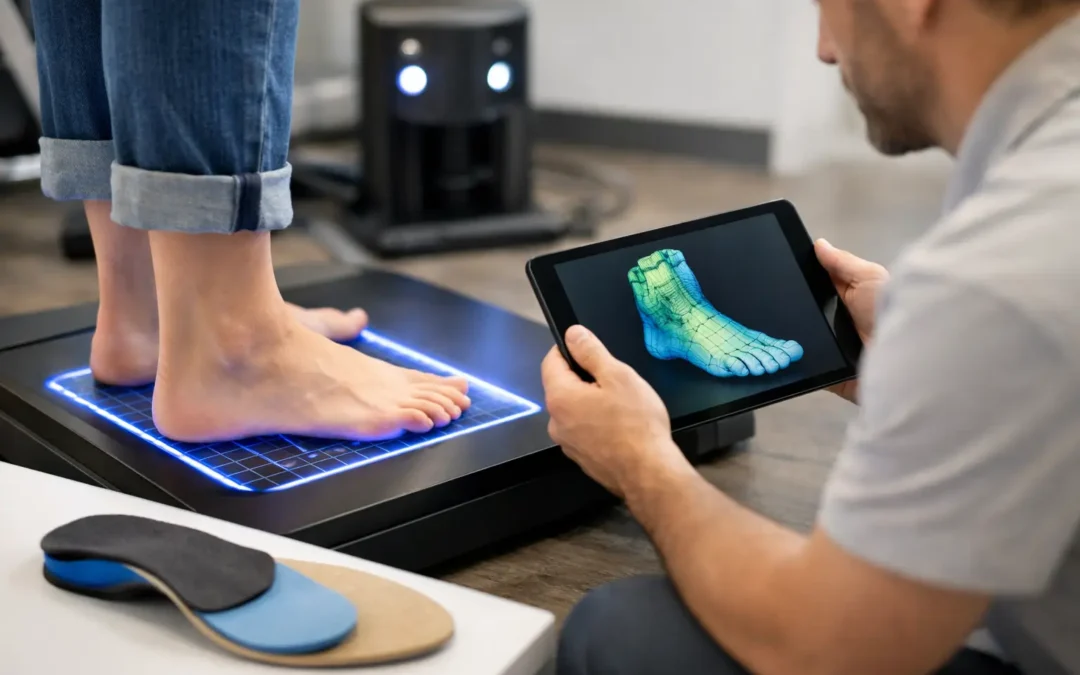
A custom orthotic should feel like it belongs in your shoe, not like something you have to tolerate. That outcome starts well before the orthotic is made. 3D foot scanning for orthotics gives your podiatrist a detailed digital picture of your feet, helping to shape a device around your individual foot structure, pressure needs and walking pattern.
For people living with heel pain, flat feet, forefoot pain, arthritis, sports injuries or ongoing fatigue in their feet and legs, small differences in fit can make a meaningful difference to comfort. A scan is not a treatment on its own. It is one part of a careful clinical assessment that helps turn the right diagnosis into a more precise prescription.
What is 3D foot scanning for orthotics?
3D foot scanning uses specialised equipment to capture the surface shape and contours of the foot. Unlike a basic shoe-size measurement, it creates a detailed digital model that can show features such as arch shape, heel position, foot width and areas where the foot may need additional accommodation or support.
The scan is quick and non-invasive. Depending on the assessment, it may be taken while you are standing, sitting or positioned in a way that allows the podiatrist to assess the foot in a corrected alignment. The information is then used alongside a physical examination, gait analysis and your symptoms to prescribe orthotics designed for your needs.
This distinction matters. Two people can have similarly shaped feet but require very different orthotics. One may need to reduce strain on the plantar fascia after recurrent heel pain, while another may need to redistribute pressure from the ball of the foot due to Morton’s neuroma. The scan provides useful measurements, but the clinical interpretation determines how those measurements are used.
Why accurate foot shape matters
Feet change over time. Weight changes, pregnancy, sporting demands, injury, arthritis and age can all affect foot shape and function. A person who has worn comfortable shoes for years may begin to notice aching arches, tired legs, pressure beneath the forefoot or pain around the big toe joint. These changes can affect how force travels through the foot with every step.
An orthotic works by influencing that loading pattern. It may support a foot that rolls in excessively, cushion a sensitive area, improve stability, accommodate a deformity or reduce movement through a painful joint. For this to be effective, the device needs to sit accurately beneath the foot and fit properly within the shoes you actually wear.
3D scanning can capture details that are difficult to reproduce consistently using older impression methods. It also creates a digital record of the foot, which can be helpful when reviewing changes or making a replacement orthotic in the future. For many patients, the process is more comfortable than having a traditional mould taken.
Fit is about more than the arch
People often assume orthotics are simply arch supports. In reality, a prescription orthotic may include support, cushioning, heel control, forefoot padding, cut-outs to offload painful areas, or modifications for specific shoe types. The design depends on the condition being treated and the activities that matter to you.
For example, an active runner with shin pain may need a different level of control and cushioning from a person with hallux rigidus, where stiffness and arthritis at the big toe joint can make push-off painful. A child with gait concerns requires a different assessment again, as growing feet must be considered carefully and treatment should never be based on a scan alone.
The scan is one part of a proper podiatry assessment
Technology is valuable when it supports clinical judgement, not when it replaces it. Before prescribing orthotics, a podiatrist should listen to what is limiting you: whether pain appears during a walk along the foreshore, after a full shift on your feet, during sport or first thing in the morning.
Your assessment may include discussion of your medical history, footwear, work demands and exercise routine. The podiatrist will examine joint movement, muscle strength, foot posture, skin and nail health where relevant, and tender structures. Gait analysis can show how your feet, knees and legs move as you walk or run.
This broader assessment helps identify whether orthotics are likely to help, and whether other treatment is needed as well. Persistent pain may require footwear changes, activity modification, stretching and strengthening, hands-on treatment, shockwave therapy, injections, imaging or referral for further care. In some cases, particularly with significant deformity or advanced joint disease, surgery may be discussed when conservative care has not provided suitable relief.
Conditions that may benefit from prescription orthotics
Prescription orthotics are commonly considered when symptoms are linked to foot mechanics, loading or pressure. They may form part of treatment for plantar heel pain, flat feet, metatarsalgia, Morton’s neuroma, bunions, knee pain influenced by foot position, Achilles tendon problems and some sports injuries.
They can also be useful for people with arthritis, including hallux rigidus, where reducing stress through a painful joint can make day-to-day walking more comfortable. For older adults, an orthotic may help improve stability or reduce pressure beneath prominent areas of the foot. For children, they may be recommended when there is pain, frequent tripping, fatigue or a gait pattern that needs support after a full clinical assessment.
That said, orthotics are not automatically the answer to every foot problem. Ingrown toenails, fungal nails, certain nerve symptoms, acute fractures and some skin conditions require different treatment pathways. A clear diagnosis avoids spending money on an orthotic that does not address the cause of the problem.
What happens after a 3D scan?
Once the assessment and scan are complete, your podiatrist prepares an orthotic prescription. This specifies the shape, materials and modifications required. Softer materials may be selected where cushioning is the priority, while firmer components may be needed to improve control or support. Many devices combine materials to balance comfort with durability.
Your usual footwear is an important part of this conversation. A slim dress shoe, school shoe, work boot and running shoe all have different space and support requirements. Bringing the shoes you wear most often to your appointment can help ensure the orthotic is practical, rather than ideal only in theory.
When the orthotics are ready, they are fitted and checked in your shoes. You will be shown how to wear them in gradually, as your feet and lower limbs may need time to adjust to a changed loading pattern. Mild awareness or muscle fatigue during the settling-in period can be normal, but ongoing pain, rubbing or numbness should be reviewed promptly.
A review protects the value of your prescription
Your symptoms, activity level and footwear can change after the initial fitting. A review appointment gives the podiatrist an opportunity to check comfort, assess your progress and make adjustments if required. This is particularly useful for growing children, highly active people, patients returning from injury and those managing progressive conditions such as arthritis.
At Manly Foot Clinic, orthotic care is approached as part of an individual treatment plan, not as a one-size-fits-all product. The aim is to help you move with less discomfort and more confidence, while addressing the factors contributing to your symptoms.
Are 3D-scanned orthotics always better?
3D scanning offers excellent detail, repeatability and comfort, but the best outcome still depends on the quality of the assessment and prescription. A highly accurate scan cannot compensate for an incorrect diagnosis, unsuitable footwear or an orthotic design that does not match your activity and symptoms.
Likewise, a more complex orthotic is not necessarily a better orthotic. Some people need substantial support and specific modifications. Others do well with a simpler, lower-profile device that fits their everyday shoes and targets one clear problem. The right choice is the one that is clinically appropriate, comfortable enough to wear consistently and aligned with your goals.
If foot or ankle pain is stopping you from exercising, working comfortably or enjoying everyday movement, a detailed assessment can clarify whether prescription orthotics are likely to help. With the right diagnosis, a 3D scan can be a practical starting point for support that is made around your feet and the life you want to get back to.