
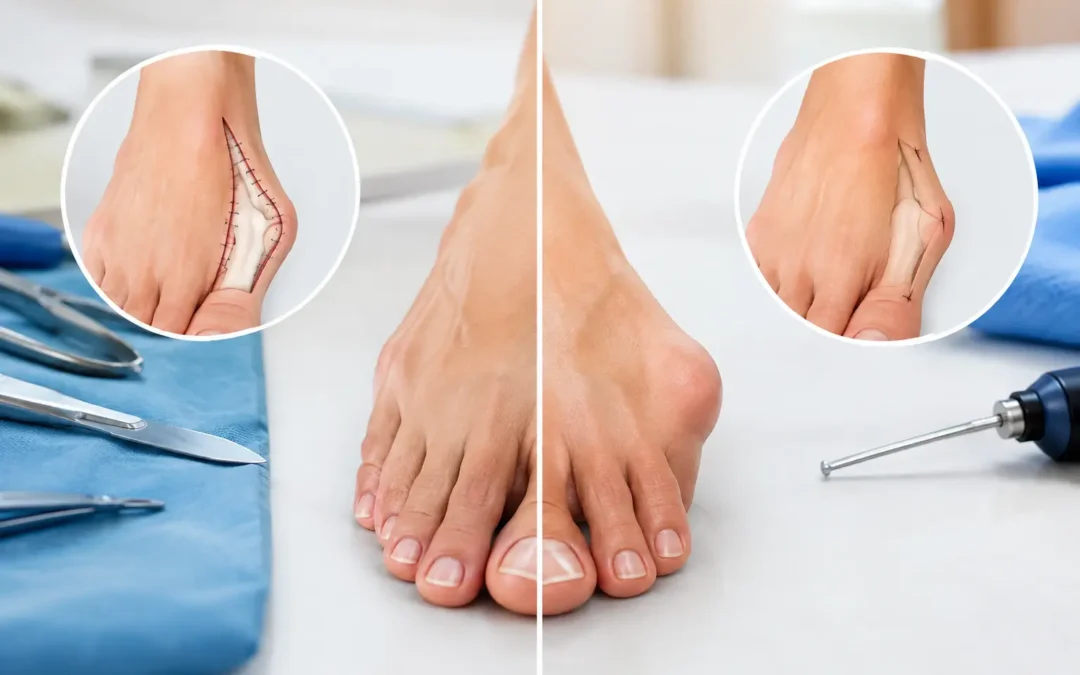
A bunion is more than a bump beside the big toe. As it progresses, the big toe may drift towards the smaller toes, footwear can become difficult to tolerate, and everyday walking may become painful. When non-surgical care no longer provides enough relief, patients often ask about open versus keyhole bunionectomy. The short answer is that both approaches can be effective, but the right procedure depends on the shape, severity and stability of your particular foot.
A careful assessment matters more than choosing a technique based on scar size alone. Bunion surgery is designed to correct the underlying alignment of the bones, not simply remove the prominent bump. The procedure needs to suit your symptoms, X-ray findings, joint health, activity needs and recovery goals.
What bunion surgery is designed to correct
A bunion, medically known as hallux valgus, develops when the first metatarsal bone and big toe move out of alignment. The visible prominence can rub in shoes, but the structural change can also affect how the foot bears weight. Some people develop pressure beneath the smaller toes, calluses, hammer toes or pain within the big-toe joint as the condition advances.
Bunionectomy is often used as a broad term for bunion surgery. In practice, surgery may involve reshaping bone, cutting and repositioning one or more bones, balancing soft tissues, and fixing the corrected position with small screws or other implants. Simply shaving the bump is rarely enough for a structural bunion, as it does not address the reason the prominence developed.
Conservative treatment is usually considered first. Wider footwear, padding, activity modifications, toe spacers, exercises and prescription orthotics may reduce pressure and improve comfort. These measures do not reverse the bony alignment, however, and surgery may be discussed when pain, shoe limitations or reduced mobility continue despite appropriate care.
Open versus keyhole bunionectomy: the main difference
Open bunion surgery uses a longer incision to allow the surgeon to see the bones, joint and soft tissues directly. This approach has a long clinical history and can be used for many types of bunion correction. Depending on the procedure, the incision may be on the side or top of the foot.
Keyhole bunionectomy is commonly called minimally invasive bunion surgery. It uses several very small incisions through which specialised instruments are used to reshape or realign the bone. The surgeon relies heavily on real-time X-ray imaging during the operation to guide the correction and placement of fixation where required.
The difference is not simply open surgery versus a smaller scar. Each approach involves a particular set of surgical techniques, and the best choice is determined by what needs correcting inside the foot. A minimally invasive procedure can still involve precise bone cuts and internal fixation. An open procedure can also be carefully planned to minimise unnecessary tissue disruption.
Open bunion surgery
Open techniques provide direct visual access to the operative area. This can be particularly useful when a bunion is severe, the deformity is complex, there is marked joint instability, or additional work is needed around the joint and neighbouring toes. Some patients also have arthritis, previous surgery, substantial rotation of the metatarsal or deformities that require correction in more than one area of the foot.
For these cases, an open approach may give the surgeon the access needed to perform a stable, accurate correction. The trade-off can be a longer incision and, for some procedures, more noticeable early swelling. Recovery still varies considerably according to the exact operation, the patient’s general health and how well post-operative instructions can be followed.
Keyhole or minimally invasive bunion surgery
Minimally invasive surgery may be suitable for selected patients with mild to severe bunion deformity, depending on the pattern of the bunion and the surgeon’s assessment. The smaller incisions may mean less disruption to superficial soft tissue and a less visible scar once healed. Some patients find this appealing, particularly when footwear and beach activities are part of their regular lifestyle on the Northern Beaches.
However, smaller incisions do not mean minor surgery. Bone healing, swelling management and protected weight-bearing remain central to recovery. Keyhole techniques also require specific training, experience and imaging equipment. The surgeon must be able to achieve and maintain the required correction without relying on a large open view of the joint.
A keyhole approach may not be the most appropriate option if there is significant arthritis, a complex recurrence after prior surgery, poor bone quality, severe instability or a need for additional joint procedures. This is not a failure of minimally invasive surgery. It reflects the fact that effective treatment should follow the anatomy, rather than force every bunion into the same technique.
What determines the best approach for your foot?
The appearance of a bunion does not always show how complex it is. Two people may have similarly sized bumps but need very different treatment plans. Clinical examination and weight-bearing X-rays help identify the position of the bones, the quality of the big-toe joint, the degree of rotation and whether other toe deformities are contributing to pain.
Your symptoms matter just as much. A bunion that looks prominent but is comfortable in footwear may not need surgery. Conversely, a less obvious bunion can be very limiting if it causes repeated rubbing, joint pain or difficulty walking for work, sport or daily errands.
Your medical history also affects planning. Diabetes, circulation concerns, smoking, inflammatory arthritis, osteoporosis and some medications can influence wound healing, bone healing and the safest recovery pathway. Expectations should be discussed openly too. Surgery aims to reduce pain, improve alignment and make shoes more comfortable. It cannot guarantee that every shoe style will be suitable or that the foot will look perfectly straight.
Recovery: what patients should realistically expect
Recovery is determined more by the procedure performed than by the size of the incision. After either open or minimally invasive bunion surgery, the foot is commonly swollen for several months. It is normal for swelling to fluctuate, particularly after standing, walking or returning to work.
Many patients need a surgical shoe or boot initially, although the timing of weight-bearing differs between procedures. Elevation, keeping dressings dry, taking prescribed medication and attending follow-up appointments are important in the early phase. Driving, work duties and return to exercise must be discussed individually, especially if your role involves long periods on your feet.
Bone healing commonly takes several weeks, while recovery of comfort, strength and confidence can continue for months. Returning to running, court sports or long coastal walks too soon can compromise the result. A gradual return, guided by clinical review and imaging where needed, gives the correction the best opportunity to heal well.
Risks and questions worth discussing
All surgery has risks, including infection, delayed wound or bone healing, nerve irritation, stiffness, swelling, blood clots, recurrence and ongoing pain. There can also be under-correction or over-correction of the toe position, and some patients may require further treatment. These risks are not identical for every technique or every person.
At your consultation, it is reasonable to ask why a particular operation is recommended, whether minimally invasive surgery is suitable for your X-rays, how the bone will be stabilised and what support you will need at home. You should also understand the expected period in a post-operative shoe or boot, when you may return to driving and work, and how future footwear choices may affect comfort.
At Manly Foot Clinic, surgical decisions are made after a detailed assessment rather than a one-size-fits-all recommendation. The aim is to select a correction that is stable, appropriate for your foot and aligned with the activities you want to return to.
If a bunion is changing how you walk, the most useful next step is not to compare scars online. Arrange an assessment, bring the shoes that give you trouble, and discuss the pain and activities you want your feet to manage comfortably again.